
Table of Contents:
The Recommended Standard: Every 6 Months
For most residential households in Hyderabad and surrounding localities like Chikkadpally and New Nallakunta, the recommended standard is to thoroughly clean and sanitize water tanks at least once every 6 months. Under less demanding conditions or where water quality is exceptionally consistent, an absolute maximum interval of 12 months may be permissible, though semi-annual cleaning remains the safest standard.
Water stored in closed tanks is not completely static or immune to external elements. Over months of regular inflow from municipal pipelines or groundwater borewells, micro-particles of silt, dissolved minerals, and atmospheric dust steadily accumulate at the bottom.
Setting a recurring 6-month cleaning cycle ensures settled silt never hardens into stubborn sludge or feeds bacterial biofilms inside your drinking and bathing reservoir.
Key Factors Influencing Cleaning Intervals
While 6 months is the general benchmark, certain local variables can require more frequent attention:
- Water Source Composition: Households relying primarily on deep groundwater borewells experience faster mineral silt sedimentation compared to treated municipal supply.
- Monsoon Season Inflow: Heavy monsoon downpours often bring higher turbidity in municipal distribution networks, demanding a post-monsoon clean.
- Tank Location & Sunlight: Rooftop overhead tanks exposed to direct sunlight heat up during summer, which accelerates photosynthetic algae growth on plastic inner ribs.
- Structural Age: Older masonry sumps with micro-rough cement plaster trap organic matter more quickly than smooth polymer tanks.
Warning Signs Your Water Tank Needs Urgent Cleaning
You do not need to guess whether your tank is due for service. Regular visual checks can give you a clear indication.
- Murky or tinted water running through overhead taps.
- A faint earthy, metallic, or stagnant smell in bathroom water.
- Frequent choking of shower heads, tap filters, or washing machine inlet strainers.
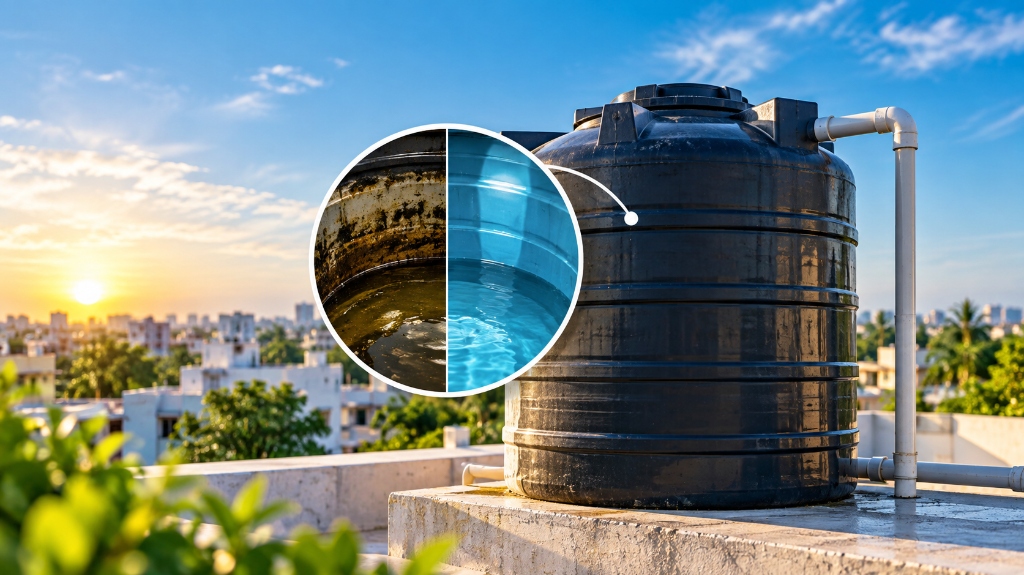
- Visible algae or dark green/brown film along the tank's inner rim upon opening the lid.
- More than six months have elapsed since the last professional service.
Why Routine Professional Maintenance Saves Money
Investing in routine water tank cleaning is significantly more cost-effective than dealing with downstream plumbing repairs. Silt buildup entering internal house pipes causes internal scaling and valve degradation. Furthermore, point-of-use domestic water filters and RO membranes expire much faster when fed with heavily sedimented tank water.
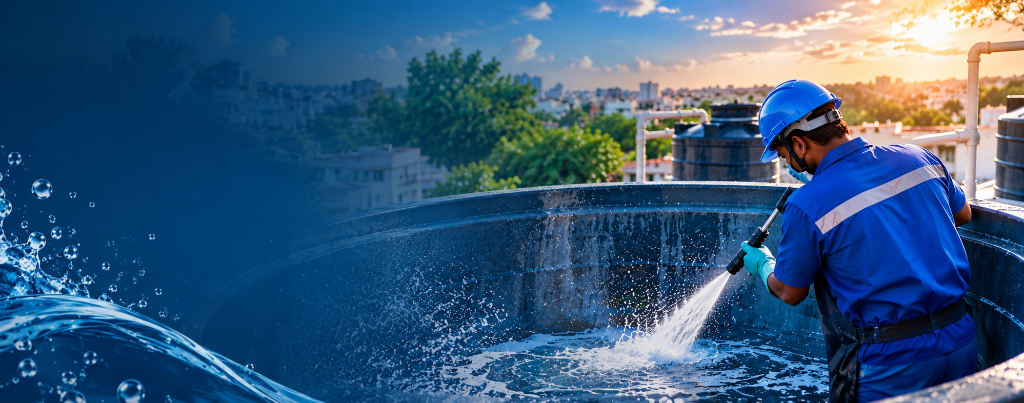
A professional cleaning team utilizes specialized sludge extraction pumps, thorough wall scrubbing techniques, and clean water flushes to restore your storage system in a couple of hours without damaging internal waterproof coatings or plastic tank walls.
Key Takeaways for Property Owners
- •Clean overhead and underground water tanks every 6 months for optimal hygiene.
- •Borewell water and post-monsoon municipal lines accelerate sediment accumulation.
- •Check your tank lids regularly to prevent airborne dust and insect ingress.
- •Timely tank cleaning protects home RO filters, bathroom plumbing, and daily water safety.